Why Your Brain Is Addicted to Distraction (And How to Break Free)
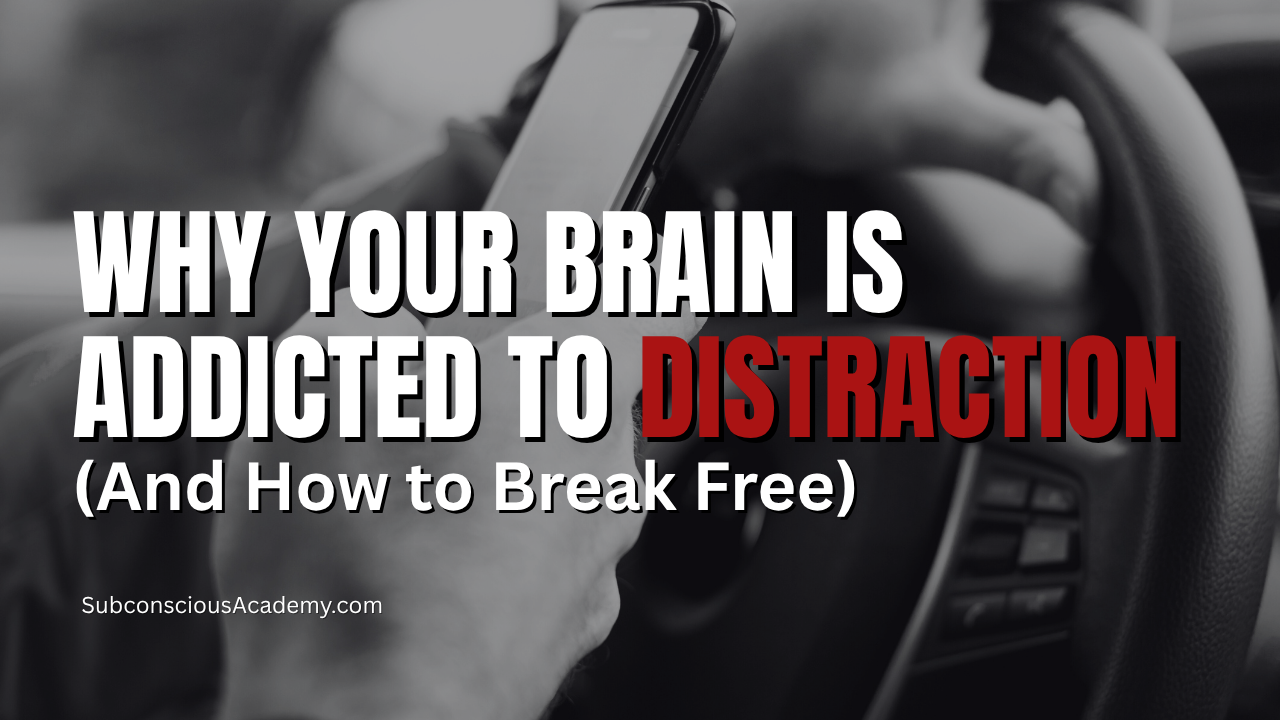
Most people assume distraction is a discipline problem. They think they lack willpower, focus, or self-control. They tell themselves they just need to try harder, set stricter rules, or cut out their phone entirely.
But that explanation never quite fits. If distraction were simply a matter of discipline, smart and motivated people would not struggle with it so consistently. Yet they do. Even when the stakes are high. Even when they genuinely care about what they are avoiding.
The truth is simpler, and more uncomfortable.
Distraction is not a character flaw. It is a learned pattern rooted in how the brain and subconscious work together.
Your brain is not just distracted. In many cases, it is conditioned to seek distraction because distraction feels safe.
Dopamine and the pull of anticipation
Every time you check your phone, refresh your inbox, or open a new tab, your brain releases dopamine. Dopamine is often described as the brain’s pleasure chemical, but that description is misleading. Dopamine is not about happiness or satisfaction. It is about motivation and anticipation.
You feel dopamine most strongly not when you receive a reward, but when you expect one.
This is why you can check your phone even when you know there is probably nothing new there. The reward is not the message. It is the possibility of the message.
Neuroscientist Wolfram Schultz demonstrated this decades ago when he discovered that dopamine spikes most when a reward is uncertain. The brain responds most powerfully to “maybe.” Maybe someone replied. Maybe something important happened. Maybe this scroll will finally deliver what you are looking for.
Dopamine is wired for pursuit, not fulfillment. It keeps you moving, scanning, checking, and reaching.
How distraction becomes a subconscious habit
This is where the subconscious takes over.
Each time you feel bored, stressed, uncertain, or emotionally uncomfortable, distraction offers quick relief. The discomfort fades, even briefly. Your subconscious does not analyze the long-term cost of that escape. It simply registers the emotional shift.
Discomfort was present. Distraction happened. Relief followed.
That sequence gets recorded.
Over time, the subconscious learns a simple rule: when something feels uncomfortable, this behavior makes it stop. The rule does not need words. It lives in sensation and emotion. And once it is installed, it runs automatically.
At that point, you are not consciously choosing distraction. The choice is made for you before you even notice the urge.
This is why distraction often shows up right before meaningful work. Not because the work is boring, but because it matters. Meaningful work introduces uncertainty. Uncertainty triggers discomfort. Distraction offers escape.
The loop reinforces itself quietly and efficiently.
Why stillness feels so hard
Distraction does not remove discomfort. It simply pulls your attention away from it.
This is why stillness can feel unsettling. When the noise stops, what you were avoiding comes back into awareness. Thoughts. Emotions. Doubts. Tension.
Centuries ago, Blaise Pascal observed that much of human suffering comes from our inability to sit quietly with ourselves. Long before modern technology, he noticed the same pattern we see today.
Rumi expressed the same idea in a gentler way. When you become quieter, you begin to hear more. What emerges in that quiet is often what distraction was protecting you from feeling.
The problem is not the discomfort itself. The problem is that your subconscious has learned to treat discomfort as a threat.
Rewiring the loop, not fighting it
Trying to break distraction by force rarely works. Removing apps, setting rigid rules, or relying on sheer discipline often backfires. The subconscious experiences that pressure as more threat, not less.
Real change begins by working with the system, not against it.
Awareness is the first step. When you notice the impulse to distract yourself before acting on it, you interrupt the automatic loop. Even a moment of awareness weakens its grip.
The next step is changing what your brain learns to reward. Right now, stimulation is rewarded. Focus often is not. When you complete something meaningful, even something small, pause long enough to feel the satisfaction. That emotional imprint matters. It teaches your brain that focus leads to safety and reward, not danger.
Stillness also needs to be reintroduced gently. If silence has been paired with discomfort, you cannot force calm. You have to make it feel safe again. A slow breath before reaching for your phone. Soft music while focusing. A brief pause instead of immediate escape.
These small experiences send a new signal to the subconscious. Stillness is not dangerous. Focus does not equal threat.
Over time, the loop changes. Focus leads to calm. Calm leads to reward. Reward reinforces focus.
This is neuroplasticity in action. The brain reshapes itself based on repeated emotional experience.
Where real change begins
These steps are not the finish line. They are the doorway.
Lasting change happens when you work directly with the subconscious patterns that created the distraction in the first place. You cannot outthink old programming. You have to update it at the level where it was formed.
If this resonates, I invite you to watch the full video below or on YouTube, where I break this down visually and experientially.
You can also take the free Mind-Control Assessment to uncover which subconscious programs are currently driving your behavior and where to begin rewiring for clarity and focus.
And if you want to go deeper, you can download the Subconscious Academy app ( App Store or Google Play). Inside, you will find the free Subconscious Starter Kit, including a guided hypnosis session and foundational tools designed to help quiet mental noise, restore focus, and retrain your subconscious for ease and flow.
Awareness is where change begins. Alignment is where it becomes effortless.
Breakthroughs Begin Within.