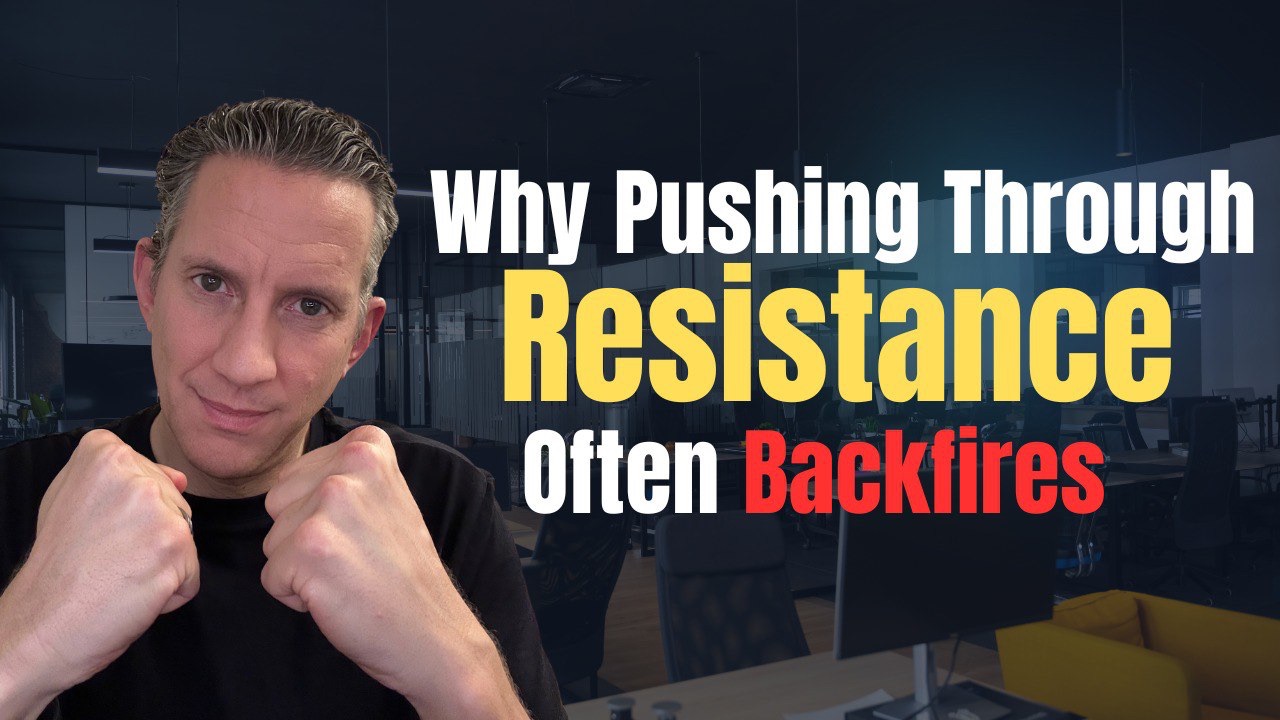
Why Pushing Through Resistance Often Backfires
There’s a particular kind of advice that circulates in entrepreneurial circles, and it sounds strong when you hear it.
Push through it.
If you feel tired, push through.
If you feel doubt, push through.
If something feels hard, it means you’re growing — so push harder.
And to be fair, sometimes that works. There are moments when discomfort is simply the cost of momentum. You override hesitation, take the action, and things move.
But if you’ve built anything meaningful over time, you’ve probably experienced a different pattern — one that’s harder to admit.
The harder you push, the more subtle resistance seems to increase.
You start the week committed and clear. You’ve mapped out what needs to happen. You know the next step. And yet somewhere in the middle of execution, something tightens. You reorganize instead of shipping. You research instead of deciding. You scroll for “just a minute” and lose half an hour.
The instinct is to interpret that as weakness. A discipline problem. A motivation issue.
So you apply more force.
And strangely, the resistance doesn’t disappear. It shifts. It becomes heavier, not lighter.
That’s usually the moment something deeper is happening.
Most of us have been trained to see resistance in binary terms. Either it’s laziness and must be overridden, or it’s intuition and must be obeyed. But resistance is rarely that simple. More often, it’s a signal from the nervous system that something about the current demand feels destabilizing.
That doesn’t mean the goal is wrong.
It means your internal system hasn’t recalibrated to the new level yet.
There’s a body of research in stress and performance psychology suggesting that moderate arousal enhances performance, while excessive stress impairs it. The Yerkes-Dodson curve is often oversimplified, but its core insight is straightforward: beyond a certain threshold, pressure begins to reduce cognitive flexibility and increase threat sensitivity.
When you push yourself into action while already operating near that threshold, the additional pressure is not experienced as motivation. It’s experienced as threat.
The amygdala becomes more active. The body tightens. Attention narrows. Decision-making becomes more rigid. You might still produce output, but it costs more than it should. It feels brittle.
And eventually, the system compensates.
Procrastination appears. Fatigue sets in. You begin avoiding the very work you told yourself mattered most.
This is where many people double down again, assuming that the solution to resistance is more discipline.
But often what’s happening is not a discipline failure. It’s a capacity mismatch.
When you attempt something that stretches identity — raising prices, increasing visibility, leading more people, stepping into a larger role — your conscious mind frames it as progress. Your nervous system frames it as uncertainty. And uncertainty is something the brain is wired to treat cautiously.
The subconscious is conservative by design. It prefers familiarity because familiarity has historically meant safety. When you grow faster than your internal calibration, resistance is a predictable byproduct.
If you respond to that resistance with force, you reinforce the idea that expansion equals threat.
If you respond with curiosity, something different becomes possible.
Instead of asking, “How do I override this?” you ask, “What about this feels destabilizing?”
Is it exposure?
Responsibility?
Judgment?
Loss of control?
When you identify the underlying tension, you can work with it rather than fighting it blindly.
This is where state regulation becomes more important than willpower.
If your nervous system is chronically elevated, every stretch feels overwhelming. But when you deliberately create calmer internal states — through breathwork, structured reflection, intentional pauses, or guided processes — you expand your window of tolerance. What previously felt threatening becomes manageable.
Growth stops feeling like something you have to force and starts feeling like something you can inhabit.
There’s an important distinction here. Not all resistance should be honored. Sometimes avoidance is simply avoidance. But reflexively pushing through everything without interpreting the signal leads to a cycle many high performers know well: sprint, strain, stall, reset.
Sustainable progress requires integration.
In the video below, I explore this dynamic more fully — how resistance shows up neurologically during expansion, how to distinguish between avoidance and overload, and how to increase internal capacity instead of applying more pressure.
If you’ve been caught in a pattern of pushing hard only to feel inexplicably blocked, it may not be a motivation issue. It may be a calibration issue.
Watch the full breakdown below or on YouTube.
And if you want a structured starting point for recalibrating your internal state rather than overriding it, the Subconscious Starter Kit inside the Subconscious Academy app includes the Sanctuary Session — a guided experience designed to help your nervous system settle and expand its tolerance for growth.
Because progress that lasts rarely comes from force alone.
It comes from alignment.
Breakthroughs begin within.