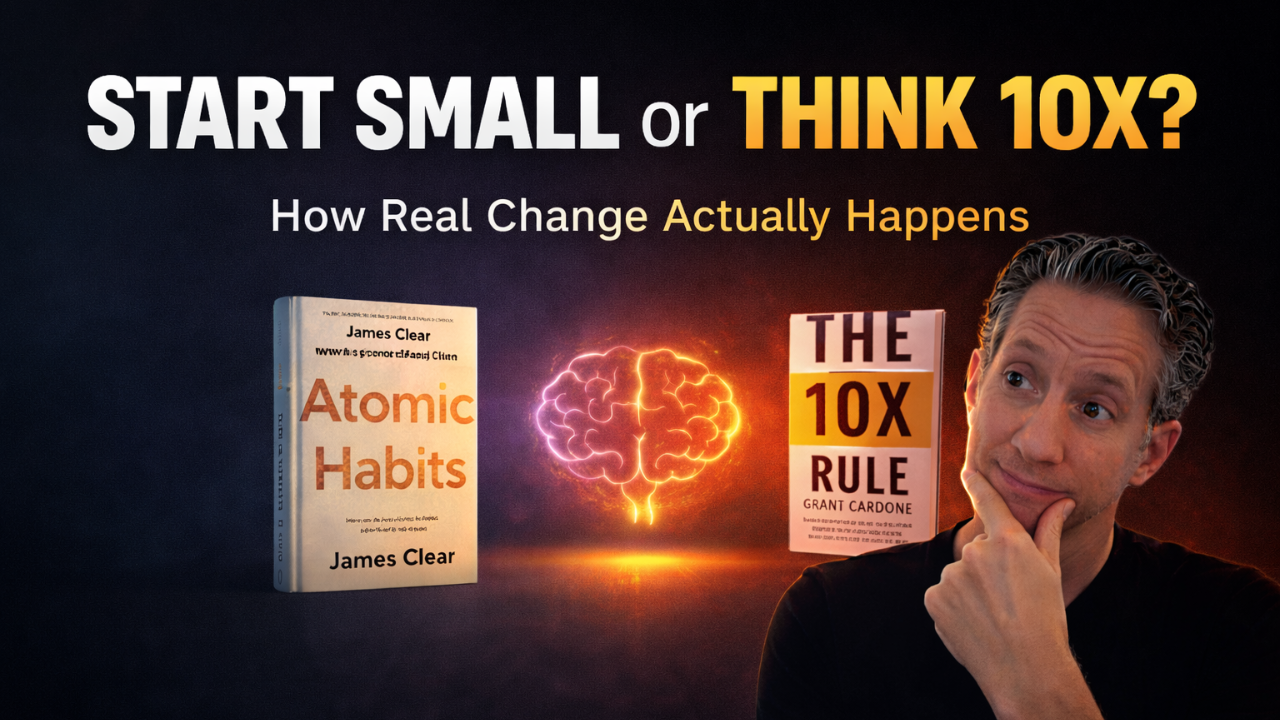
Should You Start Small or Think 10X? The Truth About How Real Change Happens
Every year around this time, people make the same promise: This year will be different.
They set goals, make resolutions, and try to convince themselves that this time they’ll follow through.
But then comes the question. Should you start small and build slow, or set a massive goal that forces growth?
The self-improvement world is split right down the middle.
On one side are the Atomic Habits believers like James Clear and BJ Fogg. They say change is built on tiny, repeatable actions that compound over time.
On the other are the 10X thinkers like Grant Cardone and Dan Sullivan. They say the only way to grow is to go big — to set goals so bold they shake your comfort zone.
So which one is right?
After nearly twenty years of working with clients and studying how the subconscious mind shapes behavior, I’ve learned this: both sides have part of the truth, but they’re missing the same thing.
They’re ignoring the subconscious.
The Real Battle Isn’t Big or Small — It’s Safety vs. Stretch
Change isn’t about how big your goals are. It’s about whether your brain feels safe enough to pursue them.
Neuroscience shows that when you try to do something unfamiliar, your brain’s threat system activates. The amygdala lights up. Your nervous system gets the message that you’re entering unknown territory — and that triggers resistance.
Small wins teach your subconscious that growth doesn’t equal danger. They help your mind build safety around progress.
But emotion is just as important. Big, emotionally charged goals light up the deeper brain networks responsible for learning and identity. Research from Stanford’s Carol Dweck and Harvard’s Robert Kegan shows that transformation often requires disorientation — those moments that challenge who you believe yourself to be.
Comfort doesn’t rewire you. Stretch does. The key is learning how to stretch without snapping.
Why Big Goals Often Backfire
You’ve probably seen this play out. Someone decides they’re going to reinvent their entire life. They start the year full of passion, saying things like, “This is my year.”
For a few weeks they’re on fire. Then the flame dies out.
It’s not laziness. It’s not lack of willpower. It’s a safety mechanism.
Their subconscious sees the goal as a threat. The leap is too far outside what it knows to be familiar. The mind slams on the brakes. Stress hormones rise. Focus and motivation disappear.
They didn’t fail because they couldn’t handle the goal. They failed because their nervous system didn’t feel safe.
Why Small Steps Can Also Fall Flat
At the same time, the “start small” approach doesn’t always work either.
Doing one push-up or writing one sentence a day can create momentum, but only up to a point. It’s easy to lose interest when there’s no emotional spark.
The subconscious doesn’t respond to logic. It responds to emotion.
You can repeat a cold, mechanical habit a thousand times and never create real change. Without meaning or feeling, the brain doesn’t register it as important. It files it under “unnecessary effort.”
To rewire your mind, progress has to feel alive. It has to matter to you.
The Science of Stretch Without Snap
The mind learns fastest when it feels safe enough to be brave.
That’s the balance you’re looking for. Push hard enough to feel alive, but not so hard that your system goes into defense.
Imagine someone who’s always stayed quiet in meetings but wants to become more confident speaking up.
If they declare, “I’m going to become a confident public speaker this year,” their subconscious will panic. It’s too big a leap. Their body will shut down before they begin.
But if they decide to simply contribute one idea in the next meeting, or offer to share a short update, it becomes manageable. The subconscious gathers evidence that being seen is safe.
Each time they stretch that edge a little further. Eventually, speaking up feels natural.
That’s how the brain rewires: small, meaningful actions with emotional weight.
Emotion Is the Real Fuel
Progress that feels meaningful releases dopamine — not as a reward for finishing, but as a signal of momentum.
As Stanford neuroscientist Andrew Huberman explains, dopamine is the molecule of motivation. It tells your system, “This direction is worth pursuing.”
But if the subconscious links your goal with fear, failure, or exposure, that same action can trigger stress instead.
Emotion determines whether your brain treats growth as danger or discovery.
A single aligned action, taken with genuine emotion, rewires you faster than a hundred forced ones.
Why Familiar Feels Safe
Abraham Maslow once said, “You can choose to go back toward safety or forward toward growth. Growth must be chosen again and again.”
Decades later, neuroscientist Joe Dispenza explained why that’s literally true. When you vividly imagine your future and attach emotion to it, your brain starts recording that vision as a memory.
The unfamiliar becomes familiar.
And what’s familiar becomes safe.
That’s why visualization works when it’s emotional, not mechanical. You’re teaching your subconscious that success isn’t foreign — it’s familiar.
Identity Is the Hidden Driver
At its core, change isn’t about what you do. It’s about who you believe you are.
James Clear said, “Every action you take is a vote for the type of person you wish to become.” But the reverse is also true: every belief you hold is a veto on who you’ll allow yourself to become.
If deep down you believe “I’m not consistent” or “I always lose motivation,” your brain will look for ways to prove that true.
Cell biologist Bruce Lipton calls this the biology of belief — the way our identity literally instructs our physiology.
Real transformation happens when your identity catches up to your intention.
The Bridge Between Purpose and Safety
Philosophers knew this long before science could measure it.
Nietzsche wrote, “He who has a why to live can bear almost any how.”
Viktor Frankl showed the same truth through experience — purpose doesn’t just inspire the mind, it stabilizes the body.
Recent research from the Max Planck Institute found that when people act from genuine purpose, the brain’s goal centers light up in sync with its survival circuitry.
Purpose doesn’t just give you drive. It makes courage feel safe.
So, Which Is It? Start Small or Think 10X?
The answer is both.
Start small enough that your subconscious feels safe, but big enough that your heart feels alive.
Stretch, but don’t snap.
Take small steps toward something emotionally charged, something meaningful.
When the subconscious feels safe, the conscious mind stops fighting it.
Action becomes natural. Growth becomes flow.
That’s how change really happens.
Take the Next Step
If this resonated with you, take the free Mind-Control Assessment to uncover how your subconscious is currently wired — and what’s been holding you back.
And if you haven’t yet, download the Subconscious Academy App ( App Store or Google Play) and start the free Subconscious Starter Kit. Inside you’ll find a guided hypnosis session that helps your mind feel safe with expansion and success.
Because breakthroughs don’t happen by accident.
Breakthroughs begin within.
Watch the full video version below or on Youtube.