Why Most New Year’s Resolutions Fail — And How to Rewire Your Mind to Keep Yours
Every January, millions of people feel that same surge of optimism. A new year, a fresh start, another chance to finally follow through. You mean it this time. You can feel the spark of possibility when you write the goals down — exercise more, launch the business, get consistent, stop procrastinating. And yet, within a few weeks, that spark fades. The gym is emptier. The notebook is forgotten. The enthusiasm turns into guilt.
It’s not a lack of discipline or willpower. It’s not laziness. The real reason most resolutions fall apart is that the conscious mind and the subconscious mind are not on the same team.
Your conscious mind loves the idea of change. It sets goals, makes plans, creates lists. But your subconscious — the part of you that runs habits, emotions, and 95 percent of daily behavior — is programmed for safety and sameness. Its first question isn’t “Will this make me happy?” It’s “Will this keep me safe?” And to your subconscious, safe means familiar.
When you decide to change, your brain literally sends out an alarm. The amygdala — your internal security system — interprets change as a possible threat. Neuroscientists have shown that even the idea of major transformation lights up the same circuits that respond to danger. That’s why you might feel resistance, hesitation, or even fatigue when you try to start. It’s not weakness. It’s wiring.
The paradox is that while one part of you craves safety, another part is always reaching to grow. Psychologist Abraham Maslow called this the drive toward self-actualization — the deep human desire to become who you’re capable of being. Every resolution is really a negotiation between those two parts of the self: the part that longs to expand and the part that insists on staying comfortable.
For many people, this battle plays out as self-sabotage. You say you’re going to wake up early, but your body feels heavy. You say you’ll record your first video, but you find a dozen reasons not to hit record. You say you’ll finally launch the project, but you get lost in small, safe tasks that don’t move the needle. You’re not avoiding the goal itself. You’re avoiding what it represents — exposure, failure, judgment, success, change.
I once coached a man who wanted to post his first social media video. He’d been talking about it for months. Every week, he’d tell me he was ready, but when it came time to record, he’d freeze. He’d adjust the lighting, rewrite his notes, or decide to wait for a better day. What we uncovered was simple: his subconscious had made a link between visibility and danger. Being seen meant being judged, and judgment felt unsafe. Once we rewired that belief, he filmed three videos that week. Same man. Same tools. Different programming.
The truth is, the subconscious doesn’t respond to logic. It responds to emotion. Neuroscientist Antonio Damasio proved that emotion, not reason, drives decision-making. Emotion is how the subconscious decides what matters and what doesn’t. When your goals carry emotional weight — when they connect to something meaningful — the brain begins to treat them as safe to pursue.
To make change stick, you have to make it feel safe. Start by lowering the threat level. Take smaller steps than your ego wants to, but fill them with purpose. Each small win sends your subconscious proof that change doesn’t equal danger. The brain is plastic — it rewires through repetition and emotion. That process, known as neuroplasticity, is how new habits become natural.
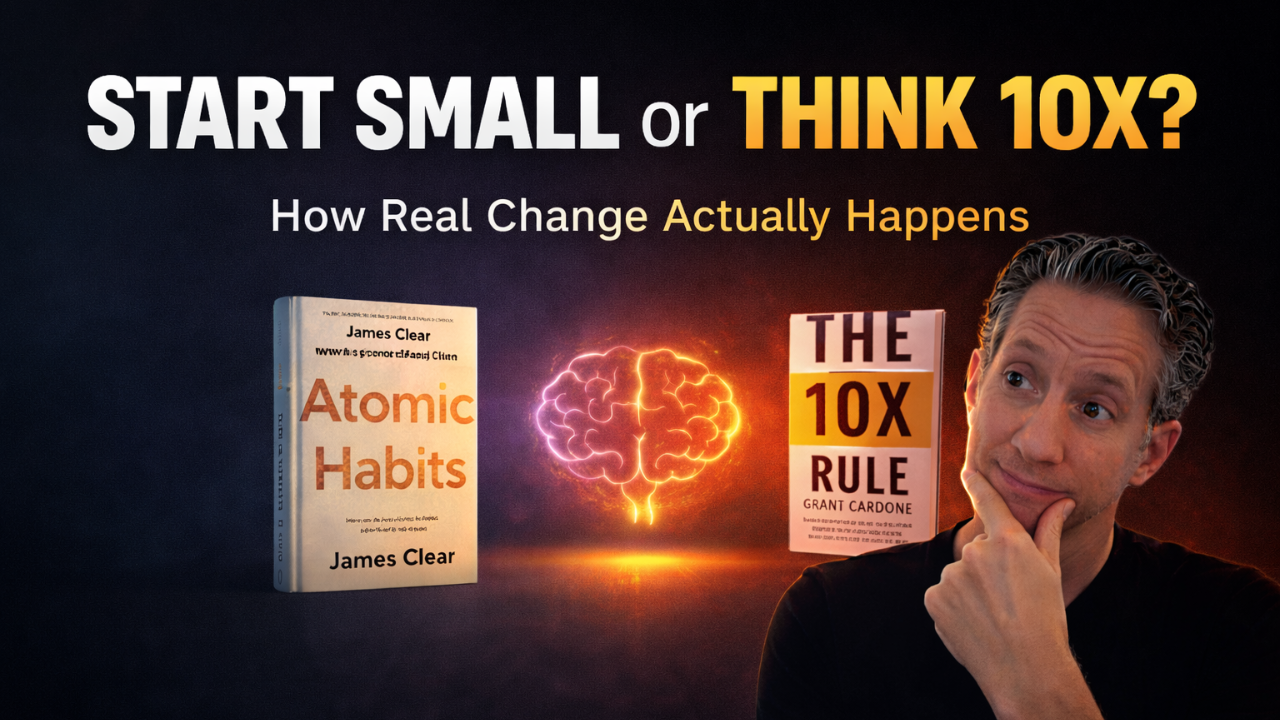
There’s a balance to find here. People often fall into one of two extremes. On one side, you have the “Atomic Habits” approach — start tiny, focus on systems, stack small wins. On the other, you have the “10x Thinking” philosophy — aim so high it forces you to become someone new. The truth is, both are right in their own way. Big goals ignite inspiration, but small actions build safety. The art is learning to stretch without snap: to hold a bold vision while expanding your comfort zone in small, emotionally charged steps.
The subconscious is like an overprotective bodyguard. Its loyalty isn’t to your goals — it’s to your survival. It will block you from doing anything it believes could get you hurt. But the bodyguard can be retrained. When you show it, through experience and emotion, that growth is safe, it begins to relax its grip.
Rebuilding self-trust is part of this process. Every time you make a promise and don’t keep it, the subconscious takes note. It learns that your words don’t match your actions. To repair that, make smaller promises and keep them religiously. Each kept promise whispers to your subconscious: I’m safe. I’m capable. I follow through. That’s how you rebuild belief from the inside out.
Psychologist William James once wrote that the greatest discovery of our generation is that a human being can change his life by changing his attitude of mind. When you change how you interpret resistance — not as failure, but as a sign your subconscious is trying to protect you — you stop fighting yourself. You start working with your own biology instead of against it.
So as you set your goals this year, don’t ask how to push harder. Ask how to make progress feel safe, meaningful, and aligned with who you’re becoming. Because when the subconscious feels safe, the conscious mind can finally soar.
If this resonates, you can watch the full video version below, where I unpack the science and strategy behind this process in more depth. You can also take the Mind-Control Assessment, which will show you how your subconscious currently prioritizes safety, success, and self-belief — and where you can start rewiring.
And if you want to experience this work directly, download the Subconscious Academy app ( App Store or Google Play) and explore the free Subconscious Starter Kit, which includes a guided hypnosis audio to help you quiet resistance and begin your own rewiring journey.
Breakthroughs begin within.