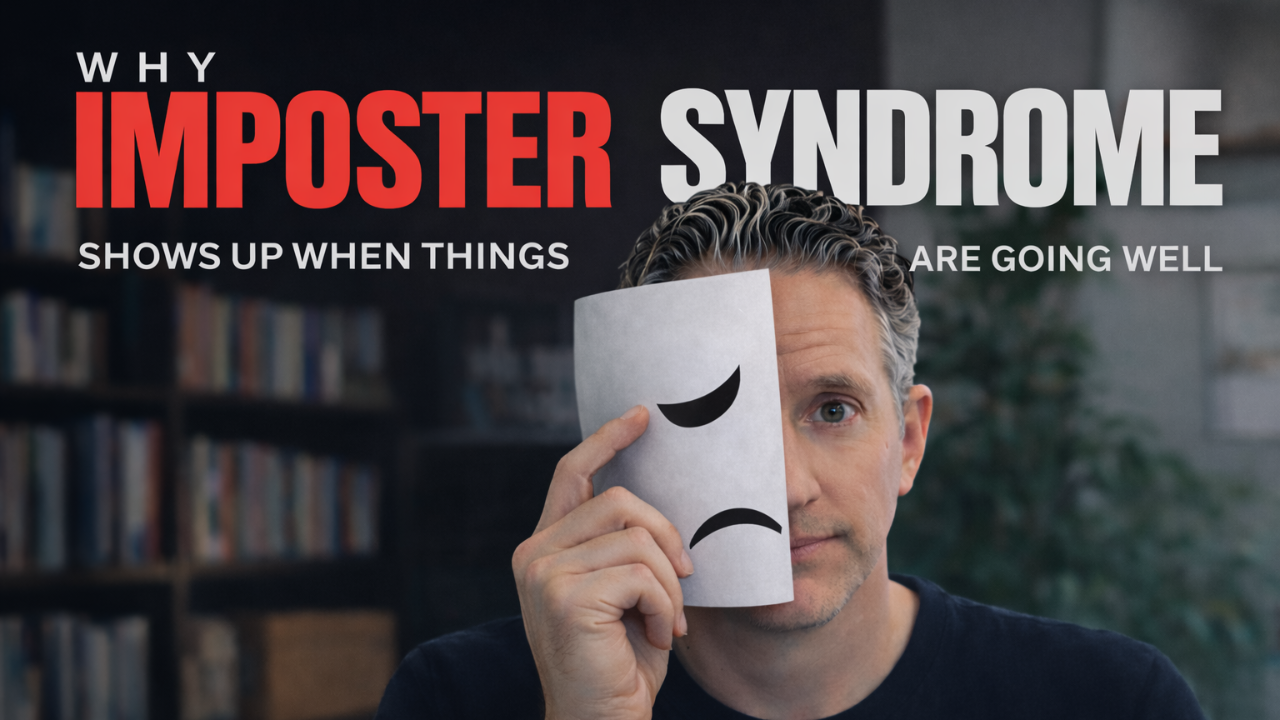
Why “Imposter Syndrome” Shows Up When Things Are Going Well
There’s a strange moment that tends to show up after things start working.
Not at the beginning, when you’re unsure or inexperienced.
But later. When momentum is real. When the work is landing. When opportunities are opening instead of closing.
That’s usually when people start questioning themselves.
They hesitate more. Decisions feel heavier. There’s a subtle sense of being exposed, like someone might tap them on the shoulder and say, “Hey… are you sure you belong here?”
Most people call that imposter syndrome.
I understand why. But I’ve never been convinced that label really explains what’s happening.
Because if this were truly about being an imposter, it would show up before things went well. It would show up when you were guessing, learning, and unproven. Instead, it tends to appear when you’re already doing the thing.
That timing matters.
What I’ve noticed, both personally and in conversations with entrepreneurs, is that this experience often shows up during expansion. When growth becomes visible. When the stakes quietly increase. When there’s more to maintain, more eyes on you, and fewer places to hide.
Something internal hasn’t quite caught up yet.
One way to understand this is through what I think of as identity lag.
External circumstances can change quickly. Internal identity usually doesn’t.
You can be operating at a new level in your work while still carrying an older internal reference point. When that happens, the system feels slightly unmoored. Not panicked. Not overwhelmed. Just unsettled.
So the mind starts searching for reasons.
Am I really ready for this?
What if I can’t sustain it?
What if I’m found out?
Those questions don’t mean you’re a fraud. They often mean your nervous system is still orienting to a new level of responsibility and visibility.
From a subconscious perspective, that makes sense. The system isn’t designed to chase growth for its own sake. It’s designed to protect familiarity. Even positive change can feel destabilizing when it stretches beyond what’s been fully integrated.
Success changes things. It narrows margins. It raises expectations. It makes outcomes feel more consequential.
So instead of excitement, what shows up is vigilance. Instead of confidence, there’s self-monitoring. Not because something is wrong, but because the system is recalibrating.
This is where the idea of a “syndrome” starts to break down for me.
Labeling this experience as a disorder subtly frames a normal adaptation process as a personal flaw. It turns transition into pathology, and that often makes the experience heavier than it needs to be.
What I see more often is not a lack of competence, but a lack of integration.
The external reality has changed faster than the internal sense of safety.
And when people try to fix that gap with pressure or reassurance, it usually backfires. Telling yourself to be more confident doesn’t settle the nervous system. Trying to silence the doubt just makes it louder.
Certainty doesn’t come from convincing yourself you belong. It comes from the system learning, over time, that this level is survivable. That it’s manageable. That nothing bad happens when you occupy it.
That’s an embodied process, not a mental one.
Which is why this phase often resolves quietly once someone stops fighting it and starts giving themselves space to adapt.
If feelings commonly called imposter syndrome are showing up while things are going well, it may not mean you’re out of your depth.
It may mean you’re in the middle of becoming someone slightly new, and your system just hasn’t finished settling there yet.
That’s not a problem to solve.
It’s a transition to move through.
If this resonates, I explore it more fully in the video below, or you can watch it directly on YouTube.
And if you want a simple way to start working with this at a deeper level, the Subconscious Starter Kit inside the Subconscious Academy app is a good place to begin.
It includes the Sanctuary Session, a guided hypnosis experience designed to help your nervous system slow down, settle, and reconnect with a calmer internal baseline. Not to force confidence, but to create the conditions where certainty can form naturally.
You can download the app here:
App Store: https://apps.apple.com/us/app/subconscious-academy/id6752501645
Google Play: https://play.google.com/store/apps/details?id=com.kj156064.app
Growth doesn’t always feel expansive at first. Sometimes it feels unfamiliar before it feels solid.
That doesn’t mean you’re doing it wrong.
Breakthroughs begin within.