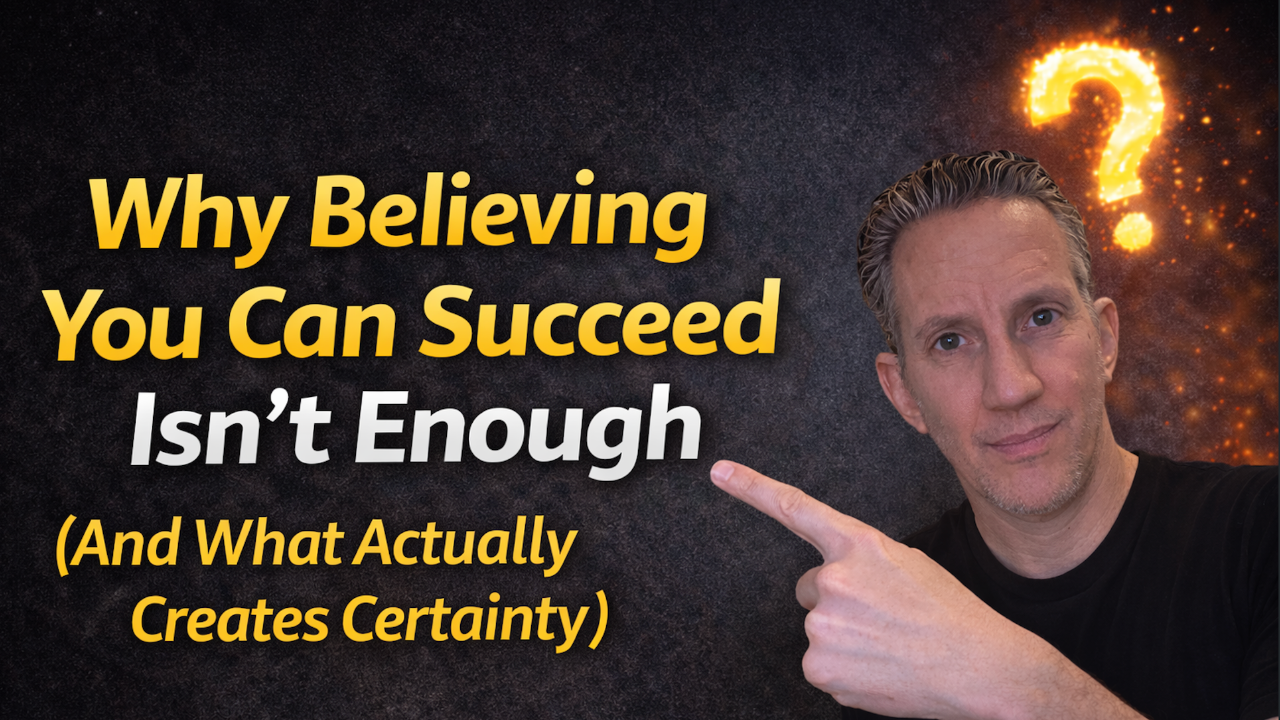
Why Believing You Can Succeed Isn’t Enough (And What Actually Creates Certainty)
One of the most common assumptions in personal growth is that action follows belief. We tell ourselves that once we truly believe in our ability to succeed, everything will fall into place. Confidence will rise. Motivation will stabilize. Movement will become natural.
But for many people, that belief never fully arrives.
They understand the idea intellectually. They agree with the possibility. They can see how it could work. And yet, they remain stuck in preparation mode, circling the same intentions, gathering more information, waiting for a feeling that never quite settles in.
The problem is not a lack of belief. It is a misunderstanding of what belief actually is.
Belief is not a thought you agree with. It is not optimism. It is not positive self-talk. Belief, in the way it influences behavior, is a felt sense of certainty. It is a state the nervous system recognizes as stable and safe enough to act from.
Until that state is present, action feels optional at best and risky at worst.
This is why people can fully endorse an idea and still hesitate. Agreement does not move behavior. Certainty does.
Most certainty is acquired the long way around. You take action. Something works. The result creates confidence. Confidence fuels further action. Over time, belief begins to feel solid.
That loop works, but only if you are already moving.
When action stalls, the loop collapses. No action means no result. No result means no certainty. So the mind looks for certainty elsewhere, often through learning, reassurance, or preparation. From the outside, this looks like procrastination. Internally, it is something far more subtle.
It is the outsourcing of certainty.
Instead of generating certainty internally or allowing action to create it externally, many people wait for it to arrive on its own. They treat certainty like a prerequisite rather than an outcome. As if once they feel ready enough, confident enough, or convinced enough, movement will finally be allowed.
But certainty does not work that way.
From a neurological perspective, belief is updated through emotionally weighted evidence, not logic alone. The brain does not recalibrate its sense of what is possible based on ideas. It recalibrates based on experience, whether that experience is physical or vividly internal.
This is why imagined experiences can feel real. It is why anxiety can arise without an external threat. And it is why visualization can be powerful when it is emotionally convincing, and completely ineffective when it is not.
The subconscious does not distinguish between something that happens and something that is deeply felt. What matters is the emotional signal.
This is also where most visualization practices fall short. People imagine outcomes without inhabiting the state those outcomes would create. They picture success without generating the felt certainty of already being capable. As a result, nothing changes internally, and behavior remains unchanged.
Certainty is built in one of two ways.
The first is external evidence: results, experience, proof accumulated over time.
The second is internal evidence: emotionally convincing internal experience that the nervous system accepts as real.
What does not work is passive waiting.
Waiting to feel ready. Waiting to feel confident. Waiting for belief to arrive.
Certainty does not arrive through time alone. It arrives through experience.
There is an old Zen story about an archer who keeps adjusting his stance, refining his grip, waiting for the perfect moment to release the arrow. Eventually, the teacher intervenes and tells him that release itself is what teaches the body. The lesson is simple but precise. Readiness is not a condition that precedes action. It is often the result of it.
A more useful question than “Do I believe I can do this?” is something quieter and more embodied.
What would certainty feel like in my body if this were already happening?
Not excitement. Not adrenaline. Not pressure.
Certainty tends to feel grounded. Settled. Calm. Almost unremarkable.
And it does not need to be intense. Even brief access to that state gives the subconscious a new reference point. A small internal experience of certainty can be enough to support a small, congruent action.
The sequence matters.
Rather than waiting for belief and then acting, certainty is accessed internally, action is taken in alignment with it, and belief grows naturally as a byproduct. Over time, the nervous system begins to treat forward movement as familiar rather than threatening.
A useful metaphor is a thermostat. Most people wait for the room to warm up before adjusting the setting. But the thermostat comes first. The environment follows.
Internal certainty sets the direction. External results catch up later.
If this pattern feels familiar, it is not a personal flaw. It is simply how the mind has learned to operate. Awareness of that pattern is not a setback. It is the first lever of change.
Where to Go Deeper
If this resonates, I also explore this idea in more depth in a short YouTube video, which you can watch below.
If you want a clearer picture of what is actually shaping your progress, not just belief but your inner alignment, habits, and subconscious patterns, the free Mind-Control Assessment was designed for that purpose. It offers a diagnostic view of how your internal programming influences follow-through and decision-making, often beneath conscious awareness.
And if you prefer to engage this work experientially rather than intellectually, the Subconscious Academy app ( App Store or Google Play) includes a free Subconscious Starter Kit. It introduces a guided hypnosis experience designed to help the nervous system settle and access a grounded internal state. That state becomes a foundation for clearer thinking, steadier action, and more natural follow-through.
Belief doesn’t move behavior.
Certainty does.
And certainty isn’t something you wait for. It’s something you learn to cultivate from the inside out.
Once you understand that, the waiting stops.
Remember: Breakthroughs begin within.