Why Success Feels Unsafe (And How to Shift It)
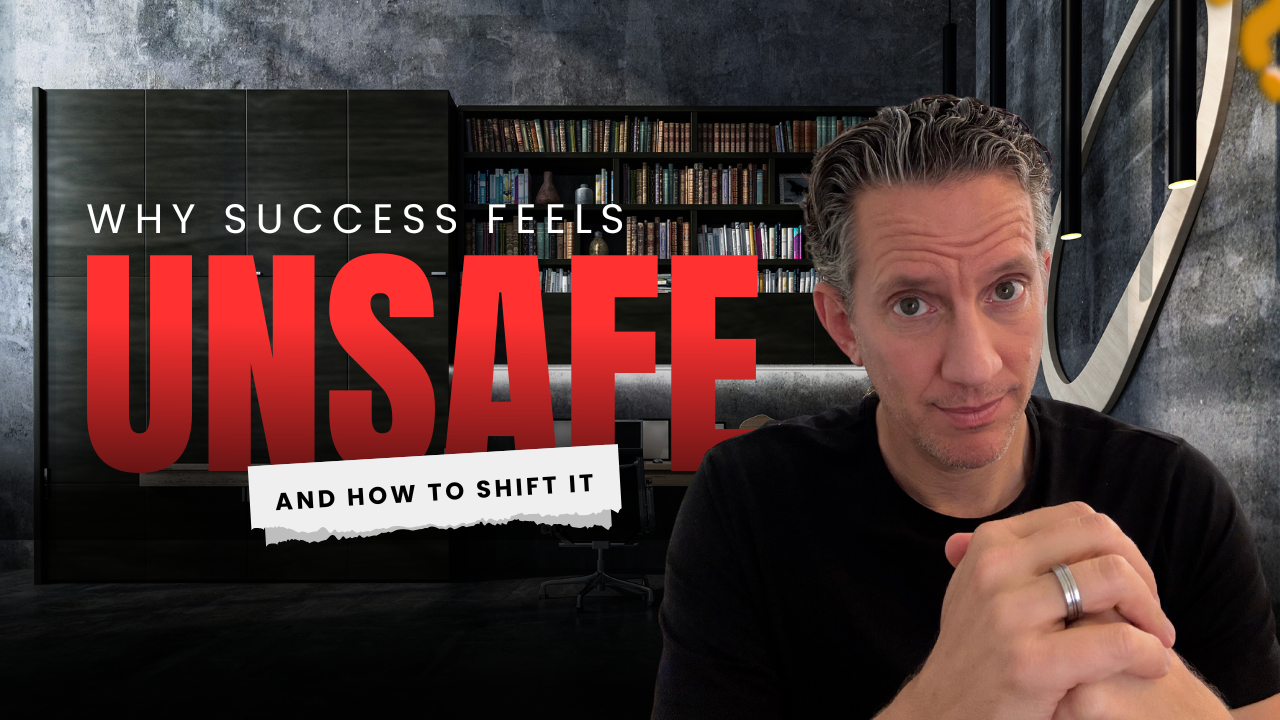
We talk endlessly about the fear of failure. It’s one of the most common explanations we reach for when progress stalls or momentum disappears.
But there’s a quieter, more uncomfortable truth that most people never consider.
For many, it’s not failure that feels threatening.
It’s success.
That idea can feel counterintuitive at first. Why would your mind resist the very thing you’ve been working toward? More freedom. More income. More visibility. More impact.
The answer lies in how the subconscious is designed.
Your subconscious does not measure outcomes by growth or achievement. It measures them by safety. Familiarity. Predictability.
Anything that represents a departure from what you already know, even something objectively positive, can register as a threat.
When success triggers protection
You can consciously want success with every fiber of your being. You can set goals, visualize outcomes, and plan your next moves carefully.
But if your subconscious associates success with exposure, judgment, pressure, exhaustion, or loss, it will quietly move to protect you.
That protection does not announce itself as fear.
It shows up as hesitation.
As perfectionism.
As distraction.
As the sense that you just need a little more clarity before you act.
From the outside, it looks like self-sabotage.
From the subconscious perspective, it is survival.
The brain’s priority is stability
Neuroscience supports this view. Researchers such as Bruce Lipton and Joe Dispenza have long emphasized that the vast majority of our behavior is driven by subconscious conditioning. The brain’s primary objective is not expansion. It is regulation.
When you push beyond what feels familiar, the nervous system often interprets that stretch as risk. The amygdala, the brain’s threat detection center, does not differentiate well between physical danger and psychological uncertainty.
As a result, the body reacts.
Heart rate increases. Cortisol rises. Focus narrows. The system subtly urges retreat.
It is not that success is inherently frightening. It is that change disrupts equilibrium.
A story about altitude
There is an old myth that captures this dynamic beautifully. In Greek mythology, Icarus escapes captivity using wings crafted from feathers and wax. His father warns him not to fly too high or too low. Too close to the sun, the wings will melt. Too close to the sea, they will become heavy.
Icarus, exhilarated by flight, rises higher and higher until the wax softens and he falls.
The story is often told as a cautionary tale about arrogance. But there is another layer that feels more relevant here.
It is not ambition that destroys us. It is our relationship with altitude.
Most people never reach the danger of flying too high because they never feel safe enough to leave the ground.
Michelangelo once observed that the greatest danger for most of us is not that our aim is too high and we miss it, but that it is too low and we reach it. Many people do not fail because success is impossible. They stop because it never becomes safe to fully pursue.
Rewiring safety, not forcing change
The encouraging truth is that this response is not fixed. The subconscious can be retrained. Safety is not static. It is learned.
Real rewiring does not happen by pushing harder or overriding resistance. It happens by changing what the nervous system associates with growth.
The first step is noticing the pattern. Pay attention to what happens when things begin to work. When progress appears, when momentum builds, when opportunity knocks. Resistance at that moment is not evidence of weakness. It is information.
The second step is redefining safety. Instead of visualizing success only in terms of outcomes, begin to imagine how it feels internally. Calm. Grounded. Present. Capable. The subconscious responds to emotional experience, not abstract goals.
The third step is rehearsal through experience. Each time you stretch yourself, pause afterward. Breathe. Let your body register that nothing bad happened. That you are still here. That expansion did not lead to danger.
These moments accumulate. Over time, the nervous system learns that growth does not equal threat. It equals evolution.
You cannot expand while holding your breath. Growth requires the body to feel included, not overruled.
When success becomes familiar
When the subconscious finally feels safe, something fundamental shifts. Effort softens. Resistance quiets. Action feels more natural.
Success stops feeling like something you have to force or defend. It starts to feel like a place you belong.
If this resonates, I invite you to watch the full video below or on YouTube, where I explore this dynamic in more depth.
You can also take the free Mind-Control Assessment to uncover which subconscious patterns are shaping your relationship with success and where to begin rewiring.
And if you want to go further, you can download the Subconscious Academy app ( App Store or Google Play) and access the free Subconscious Starter Kit. Inside, you will find a guided hypnosis session and short videos designed to help you work with your subconscious more intentionally.
Because when your subconscious feels safe, success no longer feels like a threat.
It feels like home.
Breakthroughs Begin Within.